|
|
|
|
Dear colleagues, dear friends of
the Pedagogical Section at the Goetheanum,
At the winter solstice, at Christmas time, at the turning point of the year, we send you warm greetings from the Pedagogical Section! We thank you for all the different kinds of support, for your cooperation in colloquia, conferences and publication projects, for your suggestions and donations, without which our work for the anthroposophical educational impulse would not be possible.
In many ways, our lifestyles and ways of thinking hinder the dynamics of Waldorf and Steiner education. We could perhaps gain some satisfaction in listing the many trends of our times that threaten humanity and life itself. Or we could take pleasure in devoting ourselves exclusively to our educational task.
At the meeting of the "International Council for Steiner Waldorf Education" (Hague Circle) in November at the Goetheanum, Linda Williams from Detroit (USA) pointed out a third possibility: let us clearly recognise the destructive cultural phenomena, but at the same time, be attentive to what many people are learning from the modern predicament. Danger becomes an opportunity to develop skills.
On the one hand, we experience disorder and violence in society, but on the other hand, more and more people are committed to authentic relationships and freely formed communities, to empathy and justice. On the one hand, there is fear and exclusion, but on the other hand, there is an appreciation of cultural diversity. On the one hand, there is a loss of silence, reverence and emotional depth; on the other, there is a strong yearning for meaning, art and imaginative insight. And even in view of society’s very one-sided intellectual relationship with children, Linda senses the potential for a great motivation for practical, responsible activity as soon as this is possible and permitted.
In our study work on the "Leading Thoughts"*, we also found a "third way": intelligence, when it develops into "merciless and loveless logic," reveals a cold, soulless destructiveness from which one might shudder and flee into a romantic nostalgia for the past. The third way lies somewhere between rationality and sentimentality. On this path, we see the "cold and frosty", "world-denying" tendencies of intelligence. But, in view of this fact, we develop a new ability: an "inner, heartfelt connection” with what I think, an active turning of my own feelings towards what I think. In this way, through my own activity, intelligence becomes "an expression of the heart, not just of the head".
Nurturing this kind of thinking is, after all, a key concern of Waldorf education. All the best for the new year in this exciting endeavour!
Warm regards from the Pedagogical Section at the Goetheanum.
* Rudolf Steiner – Anthroposophical Leading Thoughts – (GA 26). All quotations are taken from the article: "The World-Thoughts in the Working of Michael and in the Working of Ahriman", 16 November 1924.
|
|
|
|
|
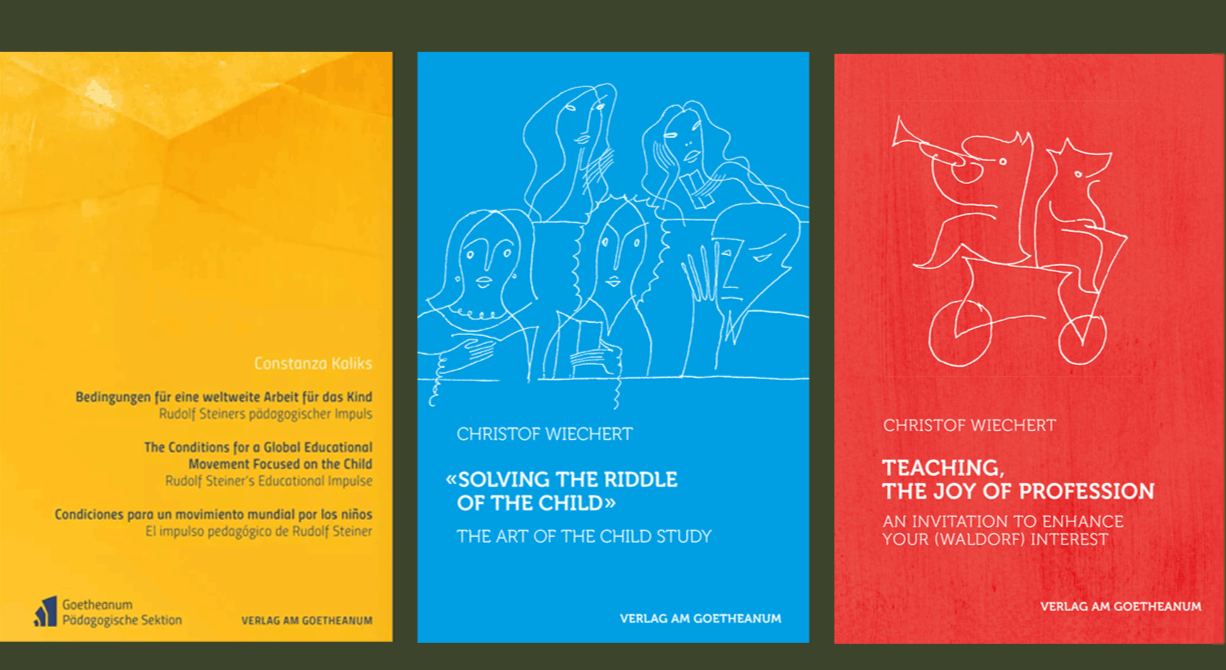
The Conditions for a Global Educational Movement Focused on the Child
Rudolf Steiner's Educational Impulse, Constanza Kaliks
In September 1919, Rudolf Steiner not only opened a new school but also laid the foundations for a worldwide educational movement. His vision was for schools to be places of learning and social participation. This text examines the prerequisites and central elements that continue to shape the innovative and empowering potential of this educational impulse to this day. (Prize of the book in the Pedagogical Section: 9 CHF/Euro)
«Solving the Riddle of the Child …»
The Art of Child Study, Christof Wiechert
It may be a truism to say that every teacher should make efforts to understand his pupils. Our real understanding, after all, can be a sure foundation and support for children’s whole development; and without this our lessons will be a random undertaking that connects with our pupils, at best, in a superficial way only. A skilled teacher seeks to understand his pupils so that he can raise learning beyond mere compulsion or drill. It was Rudolf Steiner’s ideal that the weekly pedagogical meetings in Waldorf schools should support teachers’ continually developing insight into their pupils. He exhorted them to ‘become psychologists’ but did not mean this in the commonly understood sense. He himself demonstrated this ‘art of evolving insight’ in the faculty meetings in which he participated on many occasions. One can say that it is an essential part of the quality of our work as teachers for us to develop these skills of perception, reflection and insight. Christof Wiechert here picks up these suggestions of Steiner’s anew. He elaborates from them the art of the child study as a key tool in nurturing pupils development and, at the same time, teachers’ own growing powers of insight. In short the approach described here can enliven the educational and social dimensions of a whole school community.
Teaching – The Joy of Profession
An Invitation to Enhance your (Waldorf) Interest, Christof Wiechert
To be a teacher and teaching children and youngsters is still a wonderful profession: it never gets dull or boring. But it is also a professional life under pressure. Complex demands, a high profile in professionalism, delivering sound results, yet also being attentive to the individual needs and development of the students and helping parents to understand their own child. All this demands from the teacher a multitasking talent. The teacher is constantly serving others, without time for him- or herself. Working in this profession you can easily loose your balance, the balance between inner needs and demands put on you by children, their performances, the parents and the school organism as a whole. If that happens, then we grow sour in this delightful profession. This book is a guide to find that balance which means gaining access to more energy, more creativity, more joyful responsibility for the sake of healthy students and a healthy profession.
The last two books are available in bookshops – or better still, directly from us in the Pedagogical Section for 5 CHF/Euro each.
|
|
|
|
|
|
|
|
|
Abmelden
Copyright © 2020 Allgemeine Anthroposophische Gesellschaft. Alle Rechte vorbehalten.
|
|
|
|
|